Blog

Introduction of Dars e Nizami

In the early and middle centuries, the Islamic sciences enjoyed the highest level of priority among Muslims. Islamic history is witness to a large number of scholastic centers throughout Muslim world. The central Masjid in every city and town housed an Islamic institute that would host hundreds of knowledge seekers. The legacy of knowledge that was initiated by the Qur’an and the Prophet [P.B.U.H] continued and spread far and wide, finding homes in the great learning hubs of Baghdad, Balkh, Nishapur, Herat, Isfahan, Basra, Merv, Amul, Mosul, Damascus, Cairo, Sanaa and Delhi. These centers of continued legacy not only preserved the knowledge, but also led and guided Muslims in their times of hardship. These educational centers were later termed as Madrasah (Plural Madaris). In India the history of Madaris is very old. However, the number of Madaris has enormously increased during the post-independence period. In the past, these institutions have played an important role in imparting Islamic education, increasing the literacy, and strengthening the Islamic consciousness and most importantly, providing training to the prospective civil servants. In the pre-colonial days, a graduate equipped with mathematics, logic, philosophy and the other secular sciences, along with the religious ones had better chances to get employment in the imperial civil service or in the courts of the regional rulers and nobles. Historically, Islamic education was used to strengthen and maintain “specific discourses of power,” consequently curriculum was designed accordingly to fulfill the needs of those who were in power. At first, during Akbar’s reign (1556-1605) the Madrasah curriculum was redesigned by Fatah Allah Shirazi (d.1589), a great Iranian scholar of Akbar’s court. Being himself a great scholar of rational sciences, Shirazi put emphasis on the rational sciences (m’aqulat) by adding more books on logic, philosophy, mysticism and scholasticism. On the other hand, the tradition of teaching religious sciences also flourished. This tradition was nourished by Sheikh Ahmed Sirhandi (d.1624), Sheikh Abdul Haq Muhadith Dehlvi (d.1641), Maulana Abdul Rahim (d.1718) and his son Shah Wali Ullah (d.1762). Darse Nizami (View all Dars e Nizami book here) Later a new curriculum was formulated keeping in mind the requirements of the time by Mulla Nizamudin Sihalwi (d.1748), who was contemporary of Hazrat Shah Waliullah, for Madrasah at Farangi Mahal. Later this curriculum was named after him as Darse Nizami. It became a landmark in the history of Muslim education in India and was adopted by most of the Sunni madaris of the Subcontinent. Around 10 Million students in 30000 Madaris were studying this syllabus around the world. Some amendments were introduced, particularly after the second half of the nineteenth century. Darse Nizami was meant to train administrators and to fulfill the need of ‘increasingly sophisticated and complex bureaucratic system’ of India. Dars, itself, did not demand rote learning, though it preserved the century’s old tradition of oral communication and the memorization of texts. Being tilted in favor of M’aqulat, the curriculum developed the habit of self thinking. The number of books on sciences, which strengthened the power of thinking such as scholasticism, mathematics, philosophy and logic, was higher than any other branch of learning such as Tafsir (exegesis of the Quran), Hadith (tradition of Prophet Muhammad PBUH), and Fiqh (Islamic jurisprudence). Dars was basically a standardized method of learning rather than a list of books taught to the students. The fundamental feature of this curriculum was its emphasis on widening the mental horizon and develops the habit of reading and research and analytical skills rather than rote learning, in order to develop masterly or two relatively difficult books on a discipline. However their mental ability was put to scrutinize before initiating them into that process. After completing the study they were able to comprehend other books on that discipline also. In order to promote logic and philosophy in the madaris along with religious sciences, the Dars was heavily loaded with the books on grammar and syntax, to develop language skill in Arabic, the language of the textbooks and a means for the transmission of the heritage of the Islamic tradition. All these subjects which include logic, philosophy, grammar or syntax were considered ‘Ulum-e-‘aliya, instrumental sciences. Life sketch of Mulla Nizmuddin         Mulla Nizamuddin was an originator of a great system which had far reaching effect upon the Muslim system of education. It would be proper to give a brief sketch of his life and character. Born in Sihali, a town 28 miles away from Lucknow, Mulla Nizamuddin was an illustrious son of an equally illustrious father Mulla Qutubddin Shaheed. Mulla Qutubddin was a theologian of great repute and saintly disposition and had an institution of his own which attracted a large number of students from neighboring districts. When Mulla Nizamuddin was only thirteen years old, Mulla Qutubddin, who came of Ansari family, was brutally done to death by some miscreants belonging to Uthmani family which was in long feud with the Ansaris. It was a great blow to the family indeed, but since the eldest son of the deceased was in the service of Emperor Aurangzeb, he was able to secure a royal edict from the Emperor, According by severe punishment was inflicted upon the men responsible for the murder of Mulla Qutubuddin and a spacious house in Fargangi Mahal (Lucknow) was allotted to the family of the deceased. There the whole of the Mulla’s family migrated from Sihali and made it its permanent home. Mulla Nizamuddin received his early education from his father and after his death he studied at Dewa and Banaras. At Dewa he was the pupil of Mulla Daniyal Chaurasi who had studied under Mulla Abdus Salam and who is credited to have written notes on Tawdih, Talwih and Baidawi which are considered as classics. According to Mawlana Manazir Ahsan Gilani the main reason for predominance of secular subjects in Darse Nizami is that Mulla Nizamuddin was the student of Mawlana Chaurasi who had himself received education from Mulla ‘Abdus Salam, an authority on secular learning.  It was at Banaras that

Read More »

Importance of Quran Memorization for Muslim

Importance of Quran memorization – All praise is due to Allah, the Lord of all that exists, and may prayers of blessings and peace be upon the noblest of the prophets and messenger of Allah. Indeed Allah has favored us with great bounties and tremendous blessings. From the greatest of these blessings of children, who is a delight for their parents and congratulations for the souls. Their position is between the statements of Allah when He said, “Wealth and children are the adornment of the life of this world” (18:46) And his statement, “And know that your wealth and your children are only a trial.” (8:28) And his statement, “Oh you who believe! Do not betray Allah and the Messenger, and do not betray your trust while you know it.” (8:27) From the blessings of Allah upon us is that he made the Magnificent Quran easy to memorize in the schools for Quran memorization. There are circles for Quran memorization in the Masjids that have been arranged for children, which also serves this purpose. There are also classes for Quran memorization in the evenings for women. The proof has been established and the means have been made easy for our sons and daughters to be carriers of the Book of Allah. How fantastic this would be for you, of father, if your son were to become the Imaam of the Scared Masjid in Makkah, or the Prophets Masjid in Madinah or any Masjid of the world. These Imams only came from these blessed circles that Allah has benefited the people with.   Khabbaab bin Al Aratt said to a man, “Draw near to Allah as much as you area able, know that you will never draw near to Him with anything more beloved to Him than his Words (the Holy Quran).” (Al Haakim) Ibn Masood said, “Whoever loves the Quran, then he loves Allah and His Messenger.” (At Tabaraanee) Al Haafidh as Suyootee said, “Teaching the children the Quran is a fundamental from the fundamentals of Islam. By it the child will grow up upon the fitrah, and the lights of wisdom will rush to their hearts before the desires are able to settle in them and darken them with the cloudiness of disobedience and misguidance.” Ibn Taymiyyah said, “Concerning seeking to memorize the Quran, it has precedence over much of what the people call knowledge, and is either falsehood or of little benefit.” So that the joy of the parent will be complete, they should know what is in store for their children by knocking at his great door (the door to Quran memorization). For indeed Allah has guaranteed and promised many fruits (benefits and blessings) for memorizing His Book. Below is a list of some of these benefits. 1. Elevation of their status in this life and in the hereafter because of Quran memorization. This is due to the statement of the prophet (PBUH): “Indeed Allah will elevate some people with this book and he will degrade others with it.” (Muslim) So congratulations to you that your son or daughter will be of those whose status this magnificent Quran elevates and exalts. 2. Allah intending good for your children. This is due to the statement of the prophet (PBUH), “Whoever Allah intends good for He gives him the understanding of the religion.” (Al-Bukhari) The greatest understanding of the religion is the recitation and memorization of Allah’s book, because it is the first source of legislation. 3. They will be the people of Allah and His chosen ones because of Quran memorization. This is due to the statement of the prophet (PBUH), “Verily, Allah the exalted has people from among mankind, and the people of the Quran are the people of Allah and his chosen ones.” (Ahmed and An Nisai). 4. Honouring them is a form of honouring Allah. This is due to the statement of the prophet (PBUH), “Verily, it is a form of honoring Allah, the Most high, that the gray haired Muslim is respected and the one who carries (memorizes) the Quran without exaggeration in it, nor neglecting it.” (Abu Dawood) 5. They are given precedence in leadership of the prayer (As Salah). This is due to the statement of the prophet, “The people should be lead (in prayer) by the best of them in the recitation of the Book of Allah the most High.” (Muslim) 6. They are given precedence in burial because of Quran memorization. Jaabir bin Abdullah narrated that the prophet used to put two men together of those who were killed at the battle of Uhad. Then he would say, “Which of them memorized more of the Quran?” So if one of them was pointed out he would be placed in the niche (lahd) of the grave first. (Al Bukhari) 7. Your children, boys and girls, will be protected from Shaytaan and his schemes. The prophet (PBUH) said, “Verily Shaytaan flees from the house in which Surah Al Baqarah is recited.” (Muslim) 8. They are safe from the trial of the Dajjal (the great deceiver or false messiah). The prophet said (PBUH), “Whoever memorizes ten verses from the beginning of Surah Al Kahf, he will be protected from the Dajjal.” (Muslim) 9. The position of your children in the hereafter will be the loftiest and most exalted positions. The prophet (PBUH) said, “It will be said to the person who memorized Quran, Read, ascend, recite with slow, rhythmic chanting just as you used to recite in the worldly life. For verily your position in paradise will be at the place of the last verse that you recite,” (Abu Daawood and At Tirmidhi). 10. Your child will wear the garments of honor because of Quran memorization. The prophet (PBUH) said, “The Quran will come on the Day of Judgement and say, ‘So Lord! Adorn him. ’So the person will be made to wear the crown of honor. Then it will say, ‘Oh Lord! Increase him!’ So the person will be made to wear the
Read More »

What is Salaah (Prayers)?

Salaah              The first and most important duty in Islam after one has brought faith in Allah (Subhaanahu Wata’aalaa) and in Prophet Muhammad (Sallallahu Alaihe Wasallam) and borne witness to Divine Oneness and the Apostleship of the Holy Prophet (Sallallahu Alaihe Wasallam) is Salaah (Prayers). It is a most special act of Divine worship which a Muslim is called upon to perform five times a day. There are numerous verses of the Holy Quraan and the Tradition of the Prophet (Sallallahu Alaihe Wasallam) enjoining the Salaah on us. It has been described as the pillar and the foundation of the Islam. Salaah, if it is offered with a sincere heart and proper devotion and mental concentration, is particularly vested with the property of cleansing the heart reforming one’s life and ridding it of sins and impurities. It generates love for piety and truth and promotes fear of Allah (Subhaanahu Wata’aalaa) in man. Thus it is that Islam has laid greater emphasis on it than on all other religious obligations. When anyone came to the Prophet (Sallallahu Alaihe Wasallam) to embrace Islam, the first promise the sacred Prophet (Sallallahu Alaihe Wasallam) took from him, after instructing him in Divine Oneness, was that he will offer the Salaah regularly. In fine, after the Kalimah, Salaah is the bedrock of Islam. Traditions We know from the Traditions that the Holy Prophet (Sallallahu Alaihe Wasallam) used to equate neglect of the Salaah with infidelity. He denounced it as the way of the nonbelievers. He would say that those who did not offer the Salaah had no share in the faith. A Tradition of the Prophet (Sallallahu Alaihe Wasallam) reads, “What separates a believer from infidelity is simply the Salaah.” This Tradition clearly warns that if a Muslim will give up the Salaah, he will get associated with infidelity; his conduct will become the conduct of an infidel. In another Tradition the Prophet (Sallallahu Alaihe Wasallam) has said, “He has no share in Islam who does not offer the Salaah.” And here is another Tradition from which we can imagine what a great act of virtue and felicity is it to offer the Salaah regularly and how utterly fatal and ruinous is it to neglect it. Once while urging upon the Muslims to be most particular about the Salaah, the sacred Prophet (Sallallahu Alaihe Wasallam) is reported to have observed: “Whoever will offer the Salaah properly and regularly, it will be for him on the Last Day a source of light, a proof of his faith and a means to salvation. (On the other hand) whoever will not offer it carefully and regularly, it will be for him neither a source of light, nor a proof of faith, nor a means to salvation, and the end of such a person will be with Qaaroon, Fir’aun, Haamaan and Ubai-bin-Khalf.” Brothers! Let us now imagine what our end is going to be if we failed to cultivate the habit of offering the Salaah correctly and regularly. The Ignominy and Disgrace of the Defaulters on the Last Day The ignominy and disgrace the defaulters of Salaah will have to suffer at the very outset on the Day of Judgment has been spoken of in these words in the Holy Quraan: يَوْمَ يُكْشَفُ عَن سَاقٍ وَيُدْعَوْنَ إِلَى السُّجُودِ فَلَا يَسْتَطِيعُونَ۔ خَاشِعَةً أَبْصَارُهُمْ تَرْهَقُهُمْ ذِلَّةٌ ، وَقَدْ كَانُوا يُدْعَوْنَ إِلَى السُّجُودِ وَهُمْ سَالِمُونَ۔۔ (القلم 42۔) The day that the shin shall be laid bare, and the)’ shall be summoned to bow in adoration, but the)’ shall not be able, their eyes will be cast down, ignominy will cover them, seeing that they had been summoned aforetime to bow in adoration while they were whole (and had refused). [al-Qalam 68:42,23].           The verse tells that on the Last Day when the hour of judgment will arrive (when all mystery will vanish and reality will be fully manifested) and every man and woman born into the world from the first day to the last will be raised up again and gathered together, Allah (Subhaanahu Wata’aalaa) will reveal Himself to them in full glory and splendour. Everyone will then be called upon to bow in adoration before Allah (Subhaanahu Wata’aalaa). The fortunate and the faithful among them who had been regular in their Salaah in the world and were, thus, accustomed to kneeling down before Allah (Subhaanahu Wata’aalaa) will, at once, bow down in adoration, but those who in spite of being healthy and strong had not observed the Salaah in their lifetime will find that their backs had suddenly grown stiff like a board and they will remain standing with the infidels, unable to bend down and carry out the prostration. They will be covered with ignominy, their eyes will be downcast, they will not be able even to look up. Before the chastisement of hell, they will have to bear this chastisement of humiliation and disgrace. May Allah (Subhaanahu Wata’aalaa), by His Grace, save us all from it! In truth, a habitual defaulter of the Salaah is a sort of a rebel against Allah (Subhaanahu Wata’aalaa) and deserves all the humiliation and punishment that may be meted out to him. According to some Jurisprudents of Islam, a Muslim who rejects the Salaah is liable to be punished with death like an apostate. Brothers! We must consider it thoroughly and well that without the Salaah the claim to Islam is altogether meaningless. Salaah alone is the Islamic act that joins us with Allah (Subhaanahu Wata’aalaa) and makes us deserving of His grace. Blessings of Salaah When a person stands before the Almighty with his arms folded, five times a day, and celebrates His praises and kneels down before Him and touches the ground with his forehead and makes earnest supplications to Him, he becomes worthy of His love and beneficence, his sins are forgiven with every Salaah he offers, his heart attains enlightenment and his life becomes pure. The Prophet (Sallallahu Alaihe Wasallam) once gave an excellent example to illustrate

Read More »

Benefits of Five Prayers in Islam

Salah is an Arabic word that means “worship”, a major act of worship that is obligatory on every Muslim. Salah is the 2nd pillar of Islam that needs to perform five times a day. Salah or prayer is a practical sign of obedience to the commands of Allah Almighty, the proof of our faith in Allah (S.W.T) and religion Islam. Salah is a source of direct communication with Almighty Allah. Moreover, it also refrains a person from evil deeds and bad habits. There are five daily prayers Fajr, Zuhr, Asr, Maghrib, and Isha that need to perform daily at their specified times. The establishment of Salah is one of the major topics upon which Allah (S.W.T) in the Holy Quran has emphasized more than anything else. One’s success lies in the five daily prayers. The Holy Prophet (S.A.W) said: “The first of his deeds for which a man will be called to account on the Day of Resurrection will be the prayers. If it is found to be perfect, he will be safe and successful. But if it is defective, he will be unfortunate and a loser.” Benefits of Prayers Below mentioned lines give the major benefits of Salah that elaborate on the importance and benefits of Salah. Prayer is the shield against evil deeds and bad habits. Allah Almighty says in the Noble Quran:“Verily, prayer restrains (oneself) from shameful and unjust deeds…” (Quran, 29:45) Prayer is the preferred means of invoking Allah Almighty. When a person worships Allah he or she develops a connection with Him and any invocation within that or after that connection is bound to be accepted by Allah more compared to invocation done in any other circumstance. Islamic equality shows through prayers. When Muslims offer prayer in the congregation, rich and poor, high and low, all stand shoulder to shoulder. It is the best scene of mankind’s equality in the religion Islam. Prayer satisfies our spiritual needs to be in contact with our Creator. This gives the soul peace and pleasure. Those who pray five daily prayers become humble that Almighty Allah loved and associated its success. Allah (S.W.T) says in the Holy Quran: “Successful indeed are the believers, who are humble in their prayers.” (Quran, 23:1-2) Muslims become pious and moves on the righteous path. In this regard, prayer has a great role to play as it promotes Taqwa or piety among believers. Prayer safeguards one’s physical and spiritual health. Those who offer five daily prayers their heart strengthens with the faith of Allah Almighty. Performing prayers is a means of developing a connection with Allah Almighty and when a Muslim does so five times a day, then the consequent relationship is to naturally grow strong. Prayer saves Muslims from the Hellfire. The daily five prayers are a source of comfort for the Muslims. By offering prayer, a Muslim’s misdeeds are forgiven, his good deeds duplicated and then get closer to the Lord of the Heavens and the Earth. Those who offer prayers daily can easily get rid of laziness. Salah brings on the blessings and mercy of Allah (S.W.T). Salah is the nourishment for the soul. In conclusion, Allah Almighty emphasized praying five daily prayers and explained its importance in the Holy Quran. A Muslim must realize that above anything, Salah is an obligation and every Muslim has to fulfill this obligation and get blessings from Almighty Allah.
Read More »

Translation of Azan/Adhan [Call to Prayer]

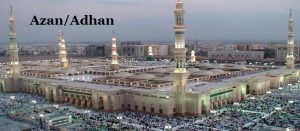
The Adhan is an announcement, with specified wording, informing the people of the occurrence of the time of the prayer. 1) The Prophet of Allah has said, “I went to paradise and saw domes of pearl and its dirt is of musk.” He said, “Oh Gabrial, who is this for?” He replied, “This if for your ummah’s Muazzin (one who says the Azaan) and Imams.” [Rawahu Abu Ya’la Fee Musnad] 2) The one who says Azaan for Sawaab is like that martyred who is drenched in blood and when he will die insects will not come on in his body. [Rawahut Tabrani] 3) If people knew how much reward there was in Azaan then swords would be used amongst them [to say it]. (Rawahu Ahmad) 4) The duaa between Azaan and Iqamah is not rejected. [Abu Daood & Tirmizi]   Allahu akbar allahu akbar – اَللهُ أَكْبَرُ، اَللهُ أَكْبَرُ Allahu akbar allahu akbar- اَللهُ أَكْبَرُ ، اَللهُ أَكْبَرُ Ash-hadu anla ilaha illah Allah – أَشْهَدُ أَنْ لَا إِلَهَ إِلَّا اللهُ Ash-hadu anla ilaha illah Allah – أَشْهَدُ أَنْ لَا إِلَهَ إِلَّا اللهُ Ash-hadu anna muhammadar-rasulullah – أَشْهَدُ أَنَّ مُحَمَّدًا رَسُولُ اللهِ Ash-hadu anna muhammadar-rasulullah – أَشْهَدُ أَنَّ مُحَمَّدًا رَسُولُ اللهِ Hayya as-salah – حَيَّ عَلَى الصَّلَاةِ Hayya as-salah – حَيَّ عَلَى الصَّلَاةِ As-salaatu khayruminan-nawm – اَلصَّلَاةُ خَيْرٌ مِنَ النَّوْمِ (in Fajr only) As-salaatu Khayruminan-nawm – اَلصَّلَاةُ خَيْرٌ مِنَ النَّوْمِ (in Fajr only) Hayya al-falah – حَيَّ عَلَى الْفَلَاحِ Hayya al-falah – حَيَّ عَلَى الْفَلَاحِ Allahu akbar allahu akbar – اَللهُ أَكْبَرُ ، اَللهُ أَكْبَرُ La ilaha illa Allah- لَا إِلَهَ إِلَّا اللهُ   Translation / Meaneing God is most great. God is most great. God is most great. God is most great. I testify that there is no god except God. I testify that there is no god except God. I testify that Muhammad is the messenger of God. I testify that Muhammad is the messenger of God. Come to prayer! Come to prayer! Come to success (in this life and the Hereafter)! Come to success! The prayer is better than sleep. Tthe prayer is better than sleep God is most great. God is most great. There is no god except God. How to say

Read More »
No more posts to show

Our Amazing Courses

This course is designed special for those students who have the first setup into Reading Holy Quran. Read More

It course enables the student to recite the Quran with advanced Tajwid unintentionally. Read More

This Course Is Designed For Students Who Are Interested In Becoming Hafiz-E-Quran or wish to memorize a part of Quran. Read More

This course includes an explanation of the five pillars of Islam, Wudhu (ablution), Biography of the prophet (PUH). Kids will memorize some Dhikr and Du’aa. Read More

This course has been specially established for those people who are fond of Quran translation, its interpretation and its Tafseer. This course enables them to find the true spirit of Allah’s message. Read More

This course is designed for those who want to learn Arabic language with complete grammar. Read More

Dars e Nizami is a traditional course to gain knowledge of religion. In this course, any book of Dars-e-nizami can be learned. Read More

Plans & Hadyas

  • 2 Day Plan $25 Monthly

    2 Days / Week, 8 Classes/Month, 30 Minuets/Class

  • 3 Days Plan $30 Monthly

    3 Days/Week, 12 Classes/Month, 30 Minuets/Class

  • 4 Days Plan $40 Monthly

    4 Days/Week, 16 Classes/Month, 30 Minuets/Class

  • 5 Days Plan $50 Monthly

    5 Days/Week, 20 Classes/Month, 30 Minuets/Class

  • Hifz Plan 1 $80 Monthly

    5 Days/Week, 20 Classes/Month, 60 Minuets/Class

  • Hifz Plan 2 $95 Monthly

    6 Days/Week, 24 Classes/Month, 60 Minuets/Class

FREQUENTLY ASKED QUESTIONS

The web based meeting and audio video software enables students to interact with real life teachers from any computer with internet access. By providing a human touch to computer education, we guide students personally in order to learn the Holy Quran effectively whilst providing an online learning experience through online interactive technology.

Yes, learning The Quran Online has been one of most helpful and effective procedures that assist Muslims all around the world about the teaching of Quran and about Islam. Our experience finds 1 to 1 online teaching effective, engaging and useful.

At an agreed time, teacher and student come online. With help of VOIP software like Teams, They talk to each other just like a telephone conversation but through computer and a screen sharing software makes them enable to see the same lesson on their computer screen. Teacher can highlight letters and words to the Quran to enhance the understanding of the student.

To join our Academy, the procedure is very simple.

Kindly go to the “REGISTRATION PAGE” and fill out the web application form, separately for each candidate, (filling in the details of only the candidate who shall study with us and not others e.g. parents, friends etc), OR call us immediately. Once you submit, your application shall be processed and if accepted, you shall receive a mail of acceptance from us. Then you shall be instructed to make the fee payment and on the receipt of the fee, your admission gets confirmed!

Please go through the “FEE STRUCTURE” before applying for any course.

Our team will communicate you as they get your admission form. Moreover, they will give you instructions to download the related software. You will get three classes as trial after admission. You can decide you will select us or not.

  • A computer system / laptop with Broadband internet.
  • A Microphone and Speakers OR headset.
  • Conversational software. (We will guide you)
  • Pen/Pencil and Notebook: Having a pencil/pen and a notebook is a very good habit while attending these classes. This shall ensure that you scribble all the important points and maintain it for revision.

Our male and female Quran teachers are highly qualified and have years of experience of online teaching. All are the graduates and certified from recognized institutions. They have a good understanding of the Quran and Islam.

Its a One-one-One session with the Teacher. So only one student studies with the teacher.